


You can polish a sculpt until the skin is flawless and the pores are immaculate, and it will still read as fake if the structure underneath is wrong. This is the lesson that catches almost every self-taught sculptor by surprise: surface detail can't rescue a bad foundation. When a character looks "soft," "puffy," or vaguely off in a way you can't quite name, the problem is almost never the skin pass. It's the muscle and bone you never resolved before you got there.
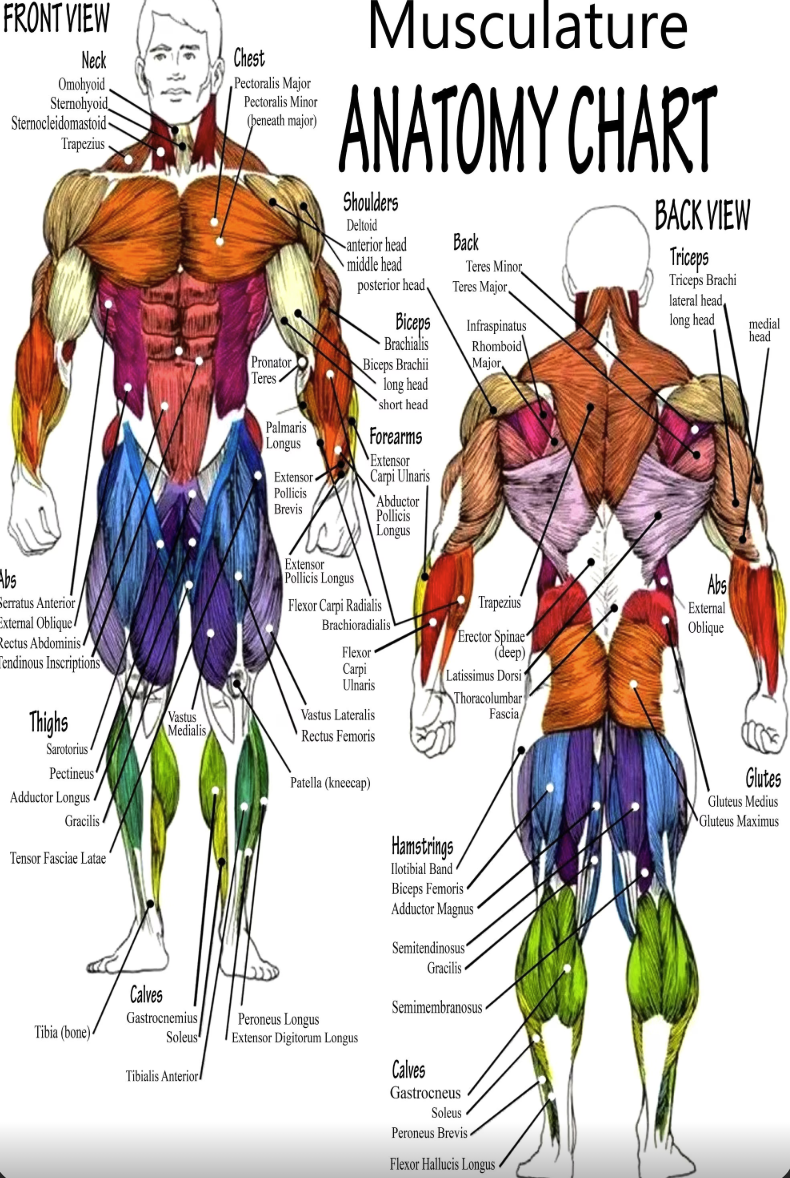
The reason is simple. Nearly every bump, plane, and hollow on the human body is the combined result of muscle, fat, and bone. Skin is just the wrapper—it faithfully reports the volume beneath it. So if you sculpt by fussing over the surface without understanding which muscle is pushing up where, or which bony point is pressing directly against the skin, your forms will never feel convincing. Strong sculptors work from the inside out: skeleton and proportion first, muscle masses on top of that, and only then the skin layer where most beginners want to start.
Not all muscles matter equally
A common trap is trying to memorize every muscle in an anatomy chart. You don't need all of them. The ones that actually shape what the viewer sees are the muscles that sit close to the surface, carry a lot of volume, or attach to bony landmarks. Learn those cold, and the rest is supporting cast.
The torso
The torso is where beginners collapse first, so it's worth the most attention.
The pectoralis major gives the upper chest its squared-off block, then fans inward and tucks toward the armpit—that fan shape is what keeps the chest from looking like two flat slabs. The rectus abdominis, the famous "six-pack," is divided into segments by horizontal tendinous bands, not by separate muscles. Two details separate a believable midsection from a generic one: the left and right columns aren't mirror images, and the segments rarely sit at the same height. Real abdomens are staggered and slightly asymmetric. Sculpt them perfectly even and they instantly look CG.
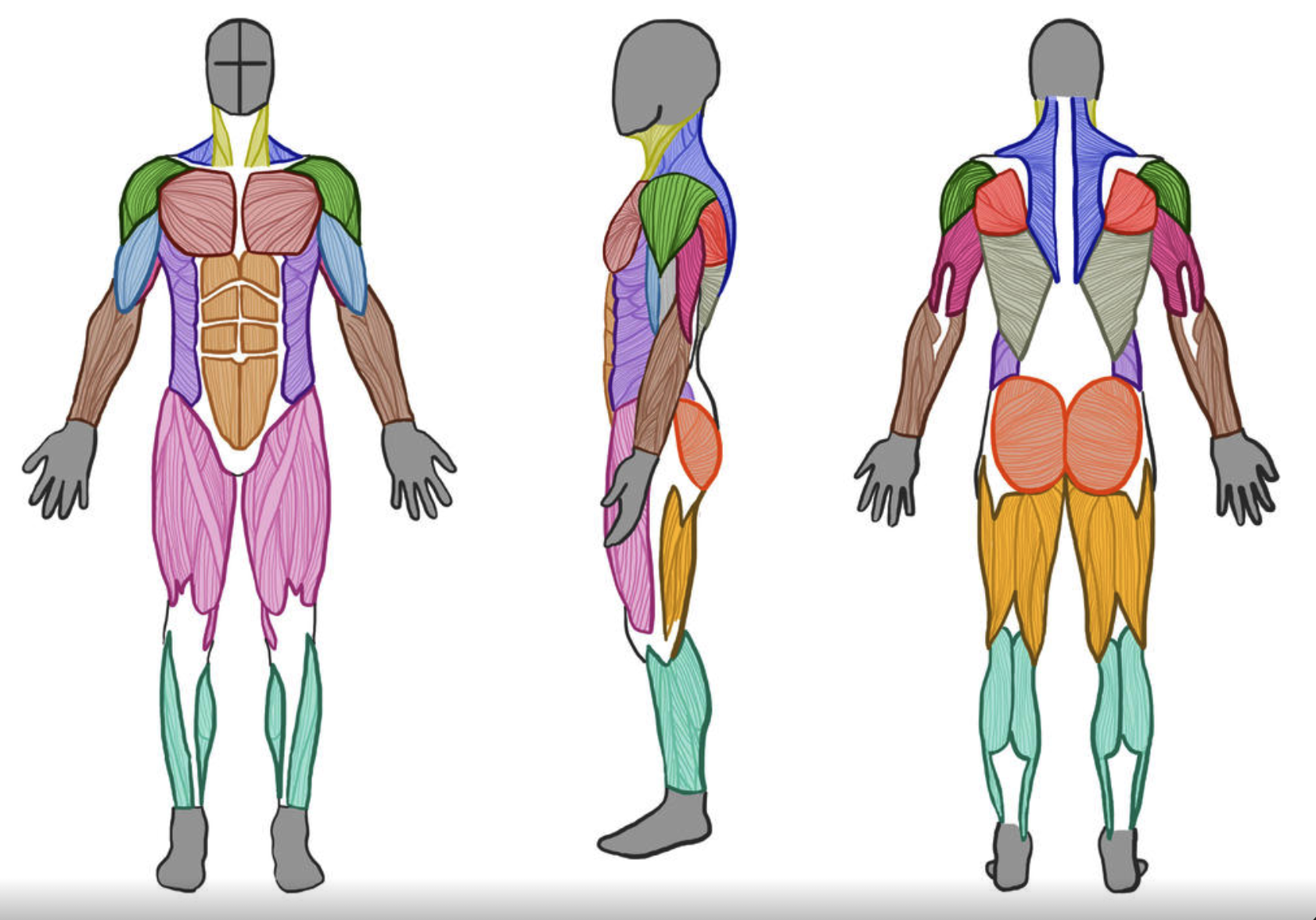
Down the sides, the finger-like serratus anterior interlocks with the external oblique, and this little zone of overlap is what makes a waist look strong and athletic. Skip it and the whole torso turns into a smooth cylinder—one of the most common giveaways of an inexperienced sculpt. On the back, two muscles drive the silhouette: the trapezius, a kite-shaped sheet running from the neck across the upper back, and the latissimus dorsi, a broad triangle sweeping down and narrowing toward the waist. Together they create that classic V-taper.
The limbs
Limbs are hard for a different reason: the muscles wrap, weave, and twist around each other rather than sitting in neat rows.
The deltoid caps the shoulder like a shoulder pad and acts as the bridge between chest and arm. On the upper arm, the biceps and triceps trade off—when one bulges, the other stretches long, and you have to sculpt that relationship rather than treating each in isolation. The forearm is the part people get wrong most often, because it's built from over a dozen long, thin muscles arranged in a spiral. It's thick and meaty near the elbow and tapers to something delicate at the wrist, and the whole bundle rotates as the hand turns from palm-up to palm-down. Miss that twist and the arm looks like a stiff tube.
In the legs, focus on the quadriceps (the big mass that bulges out on the front and outer thigh), the diagonal line of the sartorius cutting across it, and the two heads of the calf's gastrocnemius—and here's the detail to remember: the inner head sits lower and bulges more than the outer one. Sculpt the calf perfectly symmetrical and it reads as wrong even to people who couldn't tell you why.
Origins and insertions beat memorizing names
Knowing what a muscle is called is far less useful than knowing where it starts and where it ends. Every muscle runs from one point on the skeleton to another. The belly in the middle swells; the tendons at each end pull in tight. Internalize that single idea and a lot of anatomy stops being memorization and starts being logic:
- A muscle is at its fullest and roundest in the middle, and tightens down toward the joints where the tendons take over.
- When a joint bends and the muscle contracts, the belly gets shorter, thicker, and more pronounced. When it relaxes or stretches, it flattens out and lengthens.
- Bony landmarks—the clavicle, the spine of the scapula, the elbow, the knee, the front of the hip—press directly against the skin and stay put no matter the pose. They're your fixed reference points. Lock them in first, then pack muscle in between them.
This is exactly why the same character looks completely different from one pose to the next. If you build a dynamic, action pose but borrow the muscle shapes from a relaxed standing reference, it'll feel uncanny—the body language and the anatomy will be telling two different stories.
Think in planes, not sausages
The thing that separates a high-level sculpt from a competent one is plane thinking. Beginners tend to render each muscle as a rounded tube—a string of sausages—because round volumes are easy and intuitive. But muscles read as solid forms because each one faces a direction, catches light at its own angle, and produces a clean break between light and shadow. Soft, "fleshy," mushy-looking sculpts are almost always missing those plane breaks.
A practical fix: somewhere in the mid-stage, take a brush like ZBrush's Trim Dynamic or hPolish and deliberately cut flat planes into your rounded forms, then leave a touch of softness at the transitions. The form snaps into focus almost immediately—it goes from blobby to structural in a few strokes.
A workflow that respects the order of things
Putting all of this into practice comes down to resisting the urge to detail too early. A reliable order looks like this:
- Block in the big masses to nail proportion and weight, and confirm where the skeletal landmarks land.
- Add volume one muscle group at a time. Don't touch skin detail at this stage—none of it.
- Resolve how the muscles overlap and insert into each other: the lats lying over the serratus, the deltoid riding over the pec, and so on.
- Only now move to the skin layer—softening from the fat, pores, fine surface detail.
The cost of skipping ahead is real. Polish detail onto a flawed underlying structure and you'll eventually have to tear it down and rebuild, which is far more expensive than getting the foundation right the first time.
Mistakes worth catching early
A few errors show up again and again, and they're easy to fix once you know to look for them:
- Perfect symmetry. Real bodies are almost never symmetrical. A little offset reads as alive; a mirror reads as plastic.
- Edges that are too sharp. Competition-bodybuilder definition is fascinating, but it suits almost no character you'll actually sculpt. Most bodies are softer than that.
- Ignoring fat. Fat smooths over the grooves between muscles. Leave it out and even an average build looks flayed—this matters especially for women and for ordinary, non-athletic body types.
- Rubber-man joints. Joints are exactly where bone comes closest to the skin, so they should carry some hardness and structure, not be rounded over into soft putty.
None of this requires medical-level anatomy knowledge. What it requires is a habit: building from the structure outward, treating the skin as the last layer rather than the first, and trusting that if the volumes underneath are right, the surface will mostly take care of itself.


Comments (0)